Intro
US Ambassador’s Residence, Dar es Salaam, Tanzania, July 2, 2025
I was a guest at the Embassy’s 4th of July celebrations. Tanzania was without an official ambassador, so the Chargé d’affaires gave the keynote address.
I still have a visceral reaction to it. Multiple times he underlined, in a deadpan voice, that the US would engage in “trade, not aid”.
I could feel his body recoil at saying it. It was clearly a mandated talking point, but I have to think that delivering that milk-curdling line was the lowlight of his diplomatic career.
At the time, it meant very little to most of us in the courtyard at the Residence as we sucked down local craft beer, ate Pizza Hut and KFC from a market stall, and waited for the fireworks show. But within a year, that sentiment would mean everything to people walking hundreds of miles toward aid camps that no longer existed.
A country is held up by institutions, which can be thought of as chains of dominoes: such as food, politics, security, and logistics. These are separate chains and unconnected to each other, but each falls the same way: a catalyst tilts it, strain bends it, cracks run through it, and then it goes. What follows is the story of four of those chains falling at once.
Act 1: Catalysts
Upcountry Somalia, 2020
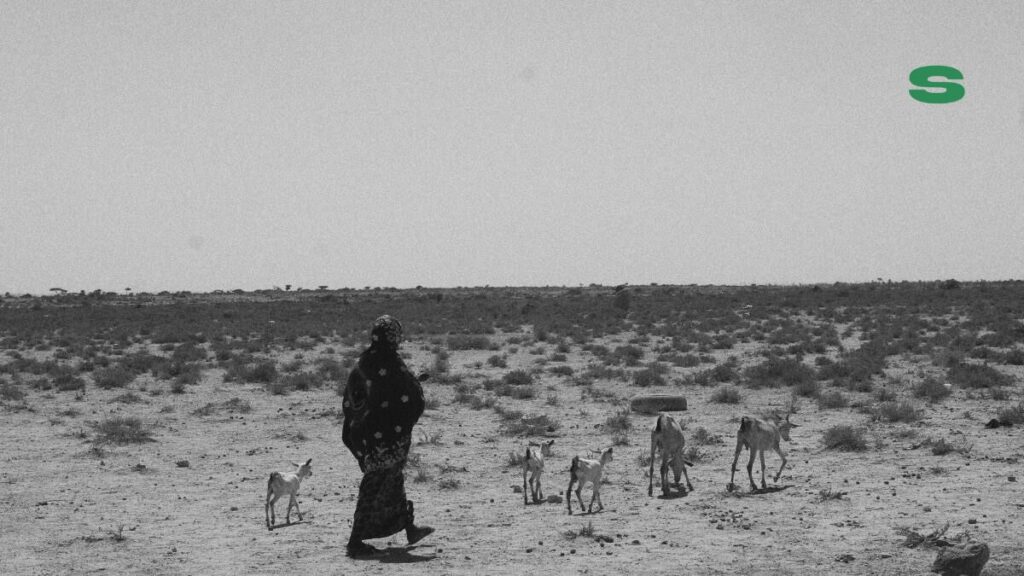
Somalia sits in the Horn of Africa and even if everything goes well, it is a hard life. Most of the population are pastoralists. The weather has to be just right, the crops have to yield perfectly, and the animals have to work hard to provide surplus calories while not getting sick.
And then you do it again for the next harvest season.
It is an incredibly marginal life and is a cycle that is nearly impossible to get out of.
In 2020 billions of desert locusts descended on the country, terrorizing crops and grazing land for livestock. Locusts are no strangers to the region, but it was the worst outbreak in generations. Entire regions of the country had their seasonal livelihoods wiped out within a few months.
I remember hearing about the swarm at the time from a couple South African helicopter pilot friends. They were hired by the UN. One would fly low to the ground and spray the locusts with a biopesticide that was not harmful to the waterways. The other would go up every couple of months to do maintenance on the rented helicopters because the blades were getting damaged by the sheer amount of bugs.
Despite the international aid in dealing with the outbreak, food supply for the country was at a breaking point until the rains came and the next harvest began.
Washington, DC, USA, 2025
For most Somalis, hunger and famine are not new. Hardship and strife are all too common in the country. As recently as 2022 a famine struck, similar in nature to what is happening now.
So when food insecurity hit a village, people didn’t just start walking hundreds of miles into the unknown. They headed to the aid camps they had gone to before. Every other time, they could reach one of 800 camps and find food and medical aid.
There had always been a safety net.
And then in November of 2024, Donald Trump came back into office with a promise of slashing global aid. By the start of his second term his administration hit the ground running: USAID closed, aid cut by 83%.
Mogadishu, Somalia, 2022
Somalia is shaped like the number 7. Mogadishu sits on the southern coast at the bottom of the 7, on the Indian Ocean.
The top portion of the country that sits on the shipping lanes of the Gulf of Aden is a breakaway region called Somaliland that maintains de facto independence since breaking away during the civil war of the early 1990s.
The land that is on the vertical axis of the 7 looks like a checkerboard of control between the federal state of Somalia and al-Shabaab. In fact, the past decade has been spent trying to unroot the al-Shabaab presence, in particular in the rural area.
Al-Shabaab promotes the formation of a hardline Islamist state. In reality they operate as a mafia that extorts the rural population under their control via taxes. Failure to pay the taxes usually ends in death.
The current phase of the war began with the 2022 election, where there was a promise of total war against al-Shabaab. And it worked…for a few years.
The strategy was to use local, clan-based militias by giving them salaries, training, and the remit to root out the jihadists. They were supported by US advisors, Swedish special operations, Turkish drones, and 15,000 African Union forces who were part of the Africa Union Transition Mission in Somalia (ATMIS).
There was wide success in the first few years with large swaths of southern Somalia liberated from terrorist control.
The Strait of Hormuz, 2026
In late February, Israel and the US launched a war against Iran, pulling the world into the conflict. Within days, the Strait of Hormuz, a narrow maritime passage between Iran and Oman was closed to shipping.
With the Strait closed, the day to day mechanics of international trade broke down. About 20% of the world’s oil, along with massive quantities of fertilizers and refined products, passes through the narrow channel.
Within a couple of days of the conflict kicking-off, tanker traffic collapsed. Commercial ships carrying emergency food and medical supplies were overnight forced to divert thousands of miles around the Horn of Africa to avoid the conflict zone.
Supply chains were stretched to their absolute breaking point because shipping insurance skyrocketed and global oil and gas markets were put on the back foot.
Act 2: Strain
Upcountry Somalia, 2022
The rains didn’t come. Not for two and half years, or the equivalent of five rainy seasons.
No rain meant no harvest, and no harvest meant no food. By the end of the year, Somalia’s food security was in a similar emergency situation as it is today. Pushed in large part by USAID, billions of emergency funding rushed into the country to keep people fed. In the end, the money to fund immediate action was there and the international food supply was able to move in.
Washington, DC, USA, 2025
On July 1st USAID officially shut down, with the remaining remit and funding obligations running through the State Department. A day later I would be standing in the courtyard of the Ambassador’s residence.
The new US funding figures came out a few months later. In Somalia’s case, what had been close to $500m in aid the year prior was cut to just $70m. But that is only one country’s aid package to Somalia. It was thought that while the $430m gap couldn’t completely be filled by other countries (such as the Europeans), maybe their giving would increase so the effect would be softer.
Instead, European countries ended up giving less as well, for a few reasons. The first is that many projects were jointly funded through USAID and European organizations. When USAID cut all funding, most joint projects lost all their funding as the Europeans didn’t want to half fund a project.
The second reason was that the countries in NATO, mainly European, came under immense pressure from the Trump administration to increase their defense spending to the newly demanded 5%. The cuts came from the international aid budgets to hit the target.
This decimated international aid on a global scale from a 2022 high of roughly $50b to less than $28b in 2025. Somalia, one of the highest recipients of international aid, was sure to feel the downstream effects of this.
I think some people were surprised just how quickly it happened.
Baidoa, Somalia, 2023
By mid-2023 the war had slowed. Supply lines were stretched thin, and al-Shabaab had begun planting IEDs at government bases. Large scale attacks pushed the government forces back.
The main issue, however, was inter-clan fighting within the security forces structure, with many militia choosing to go home after their region was liberated. The clans also fought over newly liberated resources such as grazing land and water access.
Then Somaliland signed a unilateral MOU with Landlocked Ethiopia: recognition in return for 20km of Red Sea coastline. The insult sharpens when you remember the Africa Union is headquartered in Addis Ababa.
Mogadishu read it as an assault on its sovereignty. Government forces were redirected toward the border to posture against Ethiopia.
Al-Shabaab used this as an opportunity to strengthen their grip and claw back lost territory.
Jebel Ali Port, Dubai, UAE, 2026
The impact of the war happened so fast, especially in countries like Somalia that have no domestic oil sector. Every drop has to be imported, most of it through the Strait of Hormuz.
When you think of oil arriving at a destination, most of us picture a massive supertanker. However, those vessels can only go to a limited number of ports due to their depth. Instead, the oil is unloaded in a port like Dubai from a supertanker and onto smaller feeder vessels. DP World, a port operator from Dubai, sends a feeder ship every 9 days to Somalia that has to go through the blockaded Strait.
Even though this medium sized feeder vessel is going to Somalia, not all the fuel is for the area controlled by the Mogadishu government. DP World helped build and operates a state-of-the-art terminal in the northern city of Berbera. This port is controlled by Somaliland and 35%-40% of the fuel is offloaded here, most of it bulked and transported to landlocked Ethiopia.
The feeder ship also will stop at the Bosaso Port in the north leaving behind another 10%-15% of oil in an area, Puntland, that also considers itself as autonomous.
By the time it reaches Mogadishu, only about 50% of oil remains.
While the port has plenty of storage facilities, good for about 5 months of capacity, storage operators don’t have the capital backing to keep the storage full and operate on a “just-in-time” model. Instead, it is thought that the city had about 2-3 weeks worth of fuel in reserve when the first bombs were dropped on Tehran in late February.
Act 3: Cracks
Upcountry Somalia, late 2023
When the rains finally returned, they became a double-edged sword. But it kept raining and raining this time. Soon the topsoil washed away.
The topsoil is where the nutrients live and where the water soaks in. It is the only layer where anything grows. Once that is gone, flooding easily happens.
Somalia went through terrible floods that washed away homes, destroyed crops, drowned livestock and children, and led to an ongoing cholera outbreak.
Everyone hoped 2025 would bring a normal season. But the rains didn’t come back. The flooding mixed with another drought and missed rainy seasons led to a 75% crash in crop production. For the second time in 3 years, the country could not feed itself.
Within the pastoralist families, livestock is how you build wealth: the animals are the savings account. By late 2025 the bankruptcies became all too common.
Displacement Camp, Somalia, 2026
Aid organizations just ran out of money responding to the quickly risingfamine.
The World Food Program has had to slash their emergency food assistance program from 2.2m people to 600,000. These are the people whose job is holding back famines. Now, their warehouses are empty.
Beyond food security, public healthcare has shattered. There are not enough doctors or medications to serve the people that need help, especially with malnutrition. This has led to the largest cholera outbreak globally.
One teacher, unpaid, was granted fingerprint access to a controlled card that can buy food. There is a daily limit and the organization that set it up already left the country. So the teacher must stay and buy the food daily using his finger. That finger is keeping children fed and alive, as long as there is food left to buy.
Outer arterial roads, Mogadishu, Somalia, 2026
The droughts did not slow down the al-Shabaab mafia in their demands on water usage and grazing. Even as crops failed, farmers sold their remaining livestock to pay the extortion, bankruptcy as the price of not being executed.
To make matters worse, ATMIS mission wound down through 2025, and with it the backbone of the anti-al-Shabaab campaign. As a result the mafia took more land closer and closer to Mogadishu. They would set up checkpoints on all the arterial roads coming in and out of the city.
They became the most effective taxman in the country.
Mogadishu Port Tank Farm, Somalia, 2026
And when the fuel ran out, things just stopped.
Act 4: Freefall
There is not a single moment that everything fell down. It has just been continuous backsliding for months and years.
When the Strait of Hormuz closed, fuel went from $.60 to $1.50 a liter almost overnight, and has only gone up.
The fishing industry is a jobs provider and a source of food inside Mogadishu. With Somalia having the largest coastline on the continent and its waters having one of the richest fishing grounds globally being home to valuable catches like yellowfin and bigeye tuna, marlin, mahi-mahi, and kingfish. In Mogadishu it is a major source of calories and protein.
However the sector relies on diesel powered boats. When the price of fuel skyrocketed, the first move was to only send out a partial fleet, so the catch was only half of what it had been. This also meant that the price of fish went up. As the fuel supply ran out, the larger vessels, catching the larger fish in larger quantities, stopped operating. Only small dhows would go out near shore and get what they could. All the while, what they brought back was smaller in size and catch, doubling and tripling in price as the demand for food never went down.
Another necessity is under threat: water. Public water wells in the rural interior of the country have to be pumped by heavy machinery as the water table sits hundreds of feet below the sand. These pumps require diesel generators. When there is no diesel, there is no water.
There had been a plan in place by NGOs like Mercy Corps to install solar panels to power the pumps, but when their funding was cut so were the solar projects. So very quickly water became economically impossible to reach.
For the pastoralists, their livestock died due to hunger and thirst and disease. This effectively zeroed out a family’s savings account. This means there won’t be new animals and crops, even if the rain does come. The only option for survival is to leave your land and to walk hundreds of kilometers in a drought to an aid camp.
In reality though, the likelihood in 2026 is that there is no camp. People are going to where the camps always were, in the early 1990s, in the early 2000s, in 2019. There used to be camps in all 90 districts, and today that has been cut to 21.
And if you make it to a camp, it doesn’t mean safety. In some camps only one out of every seven people get the aid because that is all that is available and they were chosen because they were the worst off. The people prioritized are the ones who may die tomorrow without a meal.
This doesn’t take into account the people working at the aid organizations and the agonizing choices they are having to make. In the past year, the ones that remain survived 80% staff cuts and are working with a skeleton crew. They kept their job to be able to make the daily choice of who gets food and who doesn’t. Working for an aid organization in Somalia is a tough, if not short, career.
Of the camps that are operating, there is the now impossible task of resupplying them, while there is an all out violent insurgency spreading across the inland districts like a spiderweb. As a result the aid organizations that still had money to operate could no longer freely move and resupply between the city and the aid camps.
And while it would seem pragmatic to just pay the toll and taxes that al-Shabaab is demanding to get aid out of the city and to where it is needed, these organizations must follow strict funding requirements and they are legally forbidden from doing it. The other option is to air lift supplies, and that eats into the little money organizations have left.
The terminal outcome of it all is displaced people are being displaced from displaced people’s camps. And while it may feel like previous famines, this time there is no backstop. There is just freefall.
Coda
As I sit here doing a final edit, I have a ping on my phone: renewed violence in Mogadishu. This time it isn’t al-Shabaab choking off the city, it’s a political crisis, after Parliament contentiously extended the President’s mandate beyond his expired term. What he wants to do with the extra year is the real fault line: universal suffrage with one person one vote, in a system where four clans have always controlled who sits in Parliament.
The clan elders answered the threat to their monopoly with mass street demonstrations and the government answered the demonstrations with soldiers, arresting opposition figures in compounds that double as militia barracks.
Now heavy urban warfare bounces through the city as personal militias fend off government forces. Early reports put the toll at around 20 dead, 250 injured…and 12,000 more people displaced from their homes.
There is no conclusion to this, just a temporary coda. I tried to pick the four most impactful domino chains that have fallen, and before I could even finish a fifth fell.
Somalia feels like a graveyard of dominos.
It wasn’t always like this. Before, whenever an institution fell, something caught the people underneath. When the locusts came, the UN sent helicopters. And when the rains stayed away, the world mobilized food. There was always a backstop: international aid was never one of the dominoes. It was the buttress holding all of them up.
And then that went away.
The dominoes were never connected. It wasn’t one chain pulling the others. Somalia is what happens when it all falls down.