Nobody really listens to the pre-landing announcement on a plane.
You are either waking up from a nap or you are trying to put your seatbelt on so the flight attendant doesn’t yell at you or you are trying to finish the last episode of Spider Noir because you know you won’t get another chance at home.
Most of the time if you are on Air Tanzania or Kenya Airways or RwandAir, you miss the announcement that single use plastic bags are banned and will be confiscated from you at the airport. And you could even get a fine, so you better listen up.
On its face, it sounds like a good idea. It feels like a very environmentally forward policy. In truth, the ban has worked.
And then you land and realize that it is a giant pain in the ass.
*
Rwanda tends to be viewed as the ringleader when it comes to these bans, first enacting the single use bag ban in 2008. There were countries that had it before, but Rwanda was the first to enforce it. Within a few years, the plaudits rolled in: they were the “pioneers” of environmentalism according to multiple papers of record.
The single use ban started from an idea to protect the agricultural sector. Initially conceived from a recommendation from a 2004 study that showed that these bags were getting into the storm drainage system and backing up the flow leading to flooding. There were also instances of livestock eating the bags and dying. For a country barely a decade out from a genocide, the ban came as a result of economic pressure as much as environmental: there was not money to spend to fix the aftereffects of the flooding or to repay farmers for dead livestock.
Throughout the mid to late 2010s, story after story got written in The New York Times (2017), Guardian (2014), and HuffPost (2013). There were interviews with border guards who would say that plastic bags were as bad as drugs and tell harrowing stories of task forces set up to stop the smugglers, who could get up to 6 months in prison for the bags.
In one article, a task force officer even lamented that the smuggling rings were getting smarter by having women bring the bags tucked in their bras and underwear. The officer admitted that they are not easy to search and that the ladies were responsible for the most extreme cases.
The accolades and applause continued to roll in despite the cost to customs enforcement, driving up the price on food, going through and removing any plastic bags being used in legitimate shipments.
While sounding like a caper, much of the pressure and enforcement has been turned to poor women, who when caught, go to prison, are beaten, extorted, and made to publicly atone.
The perception was that Africa was leading the environmental charge.
Soon the likes of Kenya and Tanzania followed suit by raising the consequences. Kenya threatened bag smugglers with 4 years in prison. Tanzania installed plastic bag surrender desks, where you can hand over the forbidden bags.
*
The real tragedy of this plastic ban, though, is how it affects me.
Since becoming law in 2019, Tanzania’s plastic bag ban has wildly inconvenienced me on many occasions, even 7 years after it went into effect.
To really understand this papercut of a policy, you have to understand how life works on a day to day basis, especially in relation to markets and shopping. There are only a few grocery stores in the traditional sense, they are just too expensive for most of the population. The main way people shop is to go to specialty stalls around town: you go to the butcher for meat, dry goods for cans and grains, and the mamas on the corner for your fruit and veg.
Most of mine, and other expats, food shopping is done at a grocery, some is done at the stalls. On one trip to a stall, not too long after the ban went into full effect, I ordered a kg of beef, and the butcher put it into an approved bag. These new bags are thicker than the single use bags, but still feel very flimsy. The handles snap off with minimal load and are prone to splitting at the seam, dropping your groceries onto the floor.
The worst place to use these bags is at the butchers. There is no way to close off the meat in the bag from the elements. Multiple times, when I make it home, I realize that I was inundated with meat juices that had soaked through the bag and onto my pants, socks, and shoes.
Have you really even lived in East Africa at this point without having a meat juice event?
And who pays for this ban (besides me obviously)? It is the Tanzanians working and shopping at the markets. I will pay for that bag that easily rips but most people can’t afford to replace it every time. My meat and fish go into a fridge within half an hour of buying it. That is not the norm.
The streets aren’t cleaner. The bags are still there, just now they are of the approved variety. They fly into the rivers just like before. The livestock can choke on them. These stupid new bags are still getting used once, just now it costs more.
*
Once enacted, the plastic bags did disappear and were replaced with bags made from non-woven polypropylene. For anyone at home thinking that non-woven polypropylene sounds a lot like plastic: correct. Does the non-woven part mean it gets used multiple times? Not at all. All the ban did was replace a useful, thin plastic bag for a thick, porous, more environmentally damaging, and more expensive single use plastic bag.
The legislation never went beyond the single use bags in most countries. There could be real change, despite the papercut feeling of it all if there was more. Why not ban single use plastic plates? Or cutlery? Or straws?
Or why not take a big swing and ban single use plastic bottles?
But at the end of the day, it is not my problem, just my nuisance.
*
A few months ago, in April, I got a ping on Whatsapp from the US Embassy. The Chargé d’affaires was coming to Mwanza the following week and had two meetings planned: one for citizens and one following it for American businesses operating in the region. The first meeting was merely a courtesy, the real meeting was the second one.
While I don’t work for an American company, I am an American working in Mwanza, so I got the invite to stay.
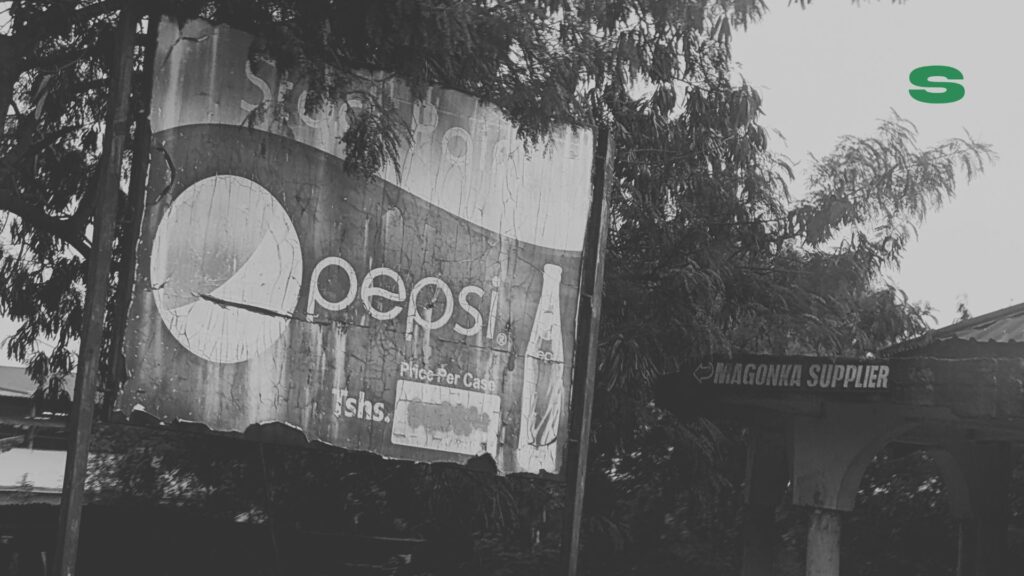
The participants in the second meeting were locals managing American businesses for heavy machinery, industrial supplies roofing and paint, and a global beverage manufacturer (for the sake of the story, it makes no difference if it was red or blue).
After a bit of calibration in understanding that the meeting would be in English and not Swahili, the tractor dealer expressed concern that while it was well known that his green tractors were the best with the best warranty and maintenance, he was being undercut by Chinese suppliers. The up front costs made it difficult to regain a foothold. The yellow excavator company shared the same concerns. We figured out that a farmer/farming co-op could buy 4 Chinese tractors for the price of one American one.
Then the beverage company manager mentioned that the Iran war was affecting his ability to get the concentrate imported. He then mentioned that really the only local product in his beverage was water. As someone with a light addiction to sodas, I asked him if there was plenty of supplies to last until the concentrate was able to be imported.
He laughed and assured me that they would be fine, though the stock of bottles may be limited because it has a shorter shelf life. He also mentioned that the plastic line was down for maintenance, but would be back up soon. That little throwaway line made me ask about the number of lines he had, glass versus plastic: turns out it is 3 glass and 1 plastic.
That plastic line is the problem, not because it was failing and was down, but because it’s winning in the market.
There was a real argument internally about retrofitting a glass line into plastic. It is a completely different process with more expensive equipment and more moving parts and more things go wrong. It is more expensive to maintain. But it is more profitable and people want plastic bottles of soda.
*
A company following market trends shouldn’t be an issue.
A glass bottle is filled and capped on the line. 20 bottles are packed into a plastic crate. Hundreds of crates are loaded onto a truck. They are unloaded around the city at collection points that act as wholesale warehouses. A deposit is given to the collection point per crate, and 2 or 3 crates at a time taken to a small stall or shop. Customers will buy a bottle from the stall, put a deposit per bottle and stand around the stall and drink the soda. It is a soda as a ritual and social experience. They return the empty bottle and get their deposit back. When a crate is full of empties, it is returned to the collection point where a new crate is taken and the initial deposit is kept. Those crates of empties get consolidated for when the delivery truck drops off the refills. They are loaded up and returned to the factory to be cleaned, filled, and capped again.
The glass beverage business across Africa really is a blueprint for the circular economy.
It is not a celebrated process, but it works.
*
From the production line, a plastic bottle is filled, capped and labeled.
From there it is on a truck directly to a shopkeeper who has asked for a selection of sodas in plastic bottles.
He will rarely take more than 6 on as inventory at any given time; the shelflife is just too small: from capped to spoilage in just under 3 months.
There is no deposit.
Once sold, the bottle is owned by the person who bought it, the same person who paid almost double for plastic over glass.
Maybe that bottle gets refilled with water and used for a bit, but it will end up in the garbage or sewers or lakes sooner rather than later.
If glass is circular, then plastic is linear.
*
I can see a world in Africa where single use plastics continued to be phased out: from cutlery to plates to straws. Rwanda had a real crack at this in 2019 with an updated plastics law.
And while bottles were a part of the policy, there is an exceptional authorization to be exempt from this. The major bottlers got that exemption, and you can still find major beverages sold in plastic bottles. But there is a hope that glass will transition into the only option.
In that sense, I commend the country and I wish that others would follow suit.
As for the non-woven polypropylene bag, they will continue to be produced from crude oil and make heat sealed bags. The same bags that need to be used at least 18 times in order to offset its higher environmental footprint compared to a conventional thin plastic bag. I can assure that most of those bags don’t make it past the 5th use, 2 times is usually the best you are going to get.
The “single use” bags have a much longer use on average than the current option.
*
I was mentally outlining this article while passing through Cairo a month or so ago. I ordered McDonalds from Uber Eats because as a fat American I short-circuit if I go too many months without a Quarter Pounder.
The driver handed me a heavy plastic bag. As I walked back to my room I realized I missed the pull of a plastic bag on my hand. The way it cinched around my fingers. While it was kilos of McNuggets, but it was easy to carry.
As silly as it sounds, I missed the single-use plastic bag.
But I am willing to sacrifice, if there is a real purpose and reason. Right now, it doesn’t feel that way. Instead, back home people are getting meat juice dripped on them after a visit to the butcher. The bags are ripping in the middle of a walk home. The bags end up in the landfill and rivers and lakes anyways.
But the bottles remain. If anything, there are more of them.
I wish there was a policy that didn’t feel like a papercut. Instead, the bottlers will do what is most profitable and everyone else will pay the price…and have to drink out of paper straws.
And in the meantime, the social ritual of drinking your soda in a glass bottle within a rock’s throw of the stall you bought it from will continue to erode.