
Well I turn to focus on the environmental on waste landscape when certain parts of stories that involved Africa come across my Desk I do like to look deep. Last week, the New York Times had a story about the famine in Somalia. As I read it, you could see the devastating knock on effects that compounded
Well most of the world is looking and watching Iran and preparing for the World Cups I keep seeing stories out of Somalia and these situation is rapidly getting worse as you zoom in you can realize that the country and society are crumbling around in real time.
Be clear it’s just never just wanted that or a singular reasons why this happens. it is not a single domino.
Instead it is the failure of multiple domino chains that are unlinked but that’s hard knocking down in unison create the situation in Somalia.
I want to look at those unique chains and understand the compounding effects of their failures to see where we are.
It take multiple domino chains to hold up a country, and it takes them all falling to bring it down. From a catalyst event that starts the tilt of the first chain, it then creates a strain on the system, that leads to cracks, and eventually that domino chain breaks.
First domino chain to fail: food supply
Somalia sits in the Horn of Africa and even if everything goes well, it is a hard life as most of the population are pastoralists. The weather has to be just right, the crops have to yield perfectly, and the animals have to work hard and provide surplus calories while not getting sick.
And then you do it again for the next harvest season.
It is an incredibly hard way of life and a cycle that is near impossible to get out of.
Starting in 2020 we can hear the first clank of a domino falling. The country was descended upon by billions of desert locusts that terrorized crops and grazing land for livestock. While the locusts are not foreign, it was the worst outbreak in generations. Entire regions of the countries had their seasonal livelihoods wiped out within a few months.
I remember hearing about the swarm at the time from a couple South African helicopter pilot friends. They were hired by the UN. One would fly low to the ground and spray the locusts with a biopesticide that was not harmful to the waterways. The other would go up every couple of months to do maintenance on the rented helicopters because the blades were getting damaged by the sheer amount of bugs.
Despite the international aid in dealing with the outbreak, food supply for the country was on a breaking point until the next harvest.
But the rains didn’t come. Not for 5 rain seasons, or two and a half years.
If the catalyst was the locusts, the strain and cracking came from the lack of rain and in turn the lack of food. By the end of 2022 Somalia’s food security was in a similar emergency situation as it is today. Pushed in large part by USAID, billions of emergency funding rushed into the country to keep the country fed. In the end, the money to fund immediate action was there and the international food supply was able to move in.
By late 2023 and early 2024, the rains returned. But it kept raining and raining this time. Soon the topsoil washed away, which is a double edged sword: the topsoil is where all the nutrients are to grow crops in large part to the organic material and carbon. It is the topsoil where crops grow. It is the organic material in the layer that allows for water absorption. Once that is gone, flooding easily happens.
Somalia went through terrible floods that washed away homes, destroyed crops, drowned livestock and children, and led to an ongoing cholera outbreak.
By 2025, it was hoped that the rains would return to normal, but the rains didn’t come back. The flooding mixed with another drought and missed rainy seasons led to a 75% crash in crop production. For the second time in 3 years, the country could not feed itself.
At this point the dominos were falling one after another.
Within the pastoralist families, livestock is how you build wealth: the animals are the savings account. So in early 2026, after years of troubles, the livestock started dying en masse due to starvation and disease. In normal circumstances, this is devastating, but in Somalia this is akin to a national banking collapse.
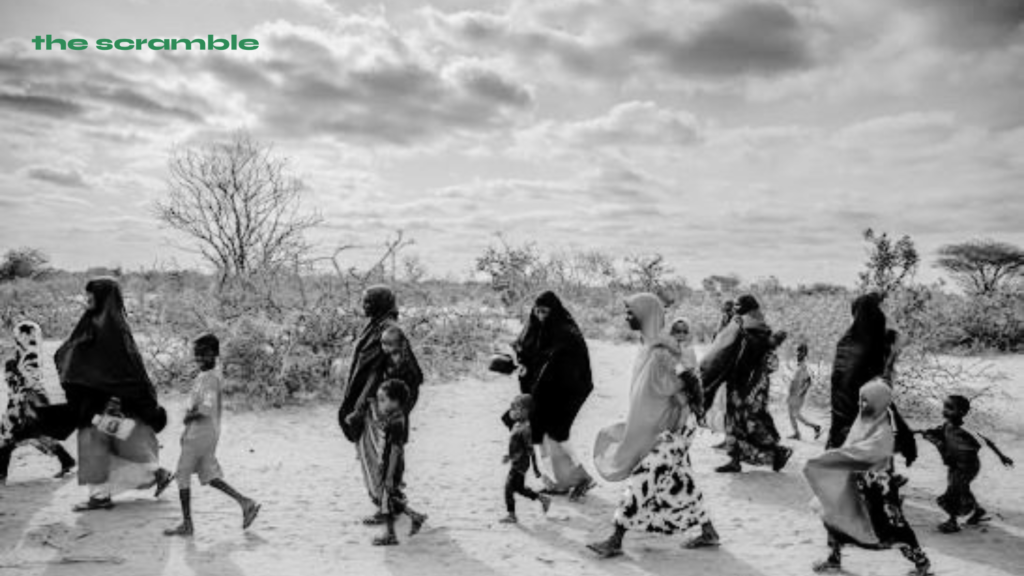
When the livestock dies, so do the future generations on a family’s land. As a result, there are no crops or livestock. There is no rain. Disease is around every corner. The option for survival is to leave your land and to walk hundreds of kilometers in a drought to an aid camp.
That is the terminal outcome of the first domino chain: hundreds of thousands (if not millions) of Somalis are in camps because there is no food.
Second domino chain to fail: changing politics
Sadly, for most Somalis this was not the first time things had gotten very bad. Hardship and strife are all too common in the country.
As recently as 2022, a famine hit the country, similar in nature to what is happening now.
So when food insecurity happened in a community, people didn’t just start walking hundreds of miles. Instead they headed to the aid camps they went to before.
Every other time this happened, they could go to one of 800 camps and get food and medical aid.
There had always been a safety net. Until now.
The catalyst happened in November of 2024 when Donald Trump came back into office with a promise of slashing global aid. At the start of his second term in early 2025 his administration hit the ground running by closing USAID and slashing aid by 83%.
On July 1st, 2025 USAID officially shut down, with the remaining remit and funding obligations running through the State Department. On July 2 I was a guest at the 4th of July celebrations for the US Embassy in Dar es Salaam. The Charge d’affairs gave the keynote address that evening. It still sticks out to me in just how cringy it was: he said that the US would now engage in trade, not aid.
It was clearly a handed down talking point. I could feel his body recoil at saying it. It meant very little to most of us in the Ambassador’s House courtyard that evening as we sucked down local craft beer and waited for the fireworks show. But it had a massive impact on those that were walking hundreds of miles to an aid camp.
The strain could be felt when the new US funding figures came out. In Somalia’s case, what had been just shy of $500m in aid the year prior was cut to just $70m. But that is just one country’s aid package to one country. It was thought that while the $430m gap couldn’t completely be filled by other countries (such as the Europeans), maybe their giving would increase so the effect would be softer.
Instead, European countries ended up giving less as well, for a few main reasons. The first is that many projects were joint funded through USAID and European organizations. When USAID cut all funding, most joint projects lost all their funding as the Europeans didn’t want to half fund a project.
The second reason was that the countries in NATO, mainly European, had immense pressure put on them from the Trump administration to increase their defense spending to the “mandatory” 2%. The shortfall came from the international aid budgets to hit the target.
This decimated international aid on a global scale from a 2022 high of roughly $50b to less than $28b in 2025. Somalia, one of the highest recipients of international aid, was sure to feel the downhill effects of this. I think some people were surprised just how quickly it happened.
The New York Times article did a great job explaining the spider web of cracks that were formed on the domino chain. Aid organizations just flat out ran out of money responding to the famine. Teachers who had been hired in camps were not being paid, but stayed as not to abandon the kids.
There is one story that a single teacher, who gets no salary, was granted fingerprint access to a controlled card that can buy food. There is a daily limit and the organization that set it up already left. So the teacher must stay and buy the food daily using his finger. That finger is keeping children fed and alive.
The World Food Program has had to slash their emergency food assistance program from 2.2m people to 600,000. These are the people that literally are known for holding back famines. Now, they have empty warehouses.
Beyond food security, public healthcare has shattered. There are not enough doctors or medications to serve the people that need help, especially with malnutrition. This has led to the largest cholera outbreaks globally.
If it isn’t clear, the breaks have happened.
This domino chain is down. It was down when the aid organizations that remained had to choose who got what aid.
In some camps only one out of every seven people gets the aid because that is what is available and that they were chosen because they were the worst off. In many cases, the people that are prioritized are the ones that literally may die the next day if they don’t get the meal.
And that is if the camp is operational. There used to be camps in all 90 districts, and today that has been cut to 21.
This doesn’t take into account the actual people working at the aid organizations and the agonizing choices they are having to make. In the past year, the ones that remain survived 80% staff cuts in some cases and are already working with a skeleton crew. They kept their job to be able to have to make the daily choice of who gets food and who doesn’t.
That is a tough, if not short, career.
In the end, displaced people are being displaced from displaced people’s camps.
The terminal outcome of this domino chain may look and feel like the previous famine. But this time, there is no safety net.
Third domino chain to fail: a population bleeding out
Conflict is a common theme throughout the past half century in the country. That has not stopped just because there is a famine and drought. Instead, it has intensified the situation.
It is important to understand the current map of Somalia to understand the conflicts going on. The country sits in the northeast of Africa and is shaped like the number 7. Mogadishu sits on the southern coast (think it’s towards the bottom of the 7) on the Indian Ocean.
The top portion of the country that sits on the shipping lanes of the Gulf of Aden is a breakaway region called Somaliand that maintains its independence from civil conflict in the early 1990s.
The land that is on the main axis of the 7 looks like a checkerboard of control between the federal state of Somalia and Isis offshoot Al-Shabaab. In fact, the past decade has been spent trying to unroot the Al-Shabaab presence, in particular in the rural area.
Al-Shabaab promote the formation of a hardcore islamic state. However, in actuality they operate as a mafia that extorts the rural population under their control via taxes. Failure to pay the taxes usually ends up in death.
The catalyst of general conflict can be traced back to the election of the new government in 2022, where there was a promise of total war against al-Shabaab. And it worked for a few years. The strategy was to use local, clan-based militias by giving them salaries, training, and the remit to root out the jihadists. Supported by US advisors, Swedish special operations, Turkish drones, and 15,000 African Union forces who were part of the Africa Union Transition Mission in Somalia (ATMIS).
There was wide success the first few years with large swaths of southern Somalia liberated from al-Shabaab. However, by strain started to show by mid-2023 with stretched supply lines and al-Shabaab starting to use IED at the bases of the soldiers. Large scale attacks forced the government forces back. But the main issue was inner-clan fighting within the security forces structure, with many militia choosing to go home after their region was liberated. The clans also fought over new liberated resources such as grazing land and water access.
The cracks came through when Somaliland signed a unilateral MOU with land-locked Ethiopia that exchanged recognition as an independent country in exchange for 20 km of coastline on the Red Sea. The issue is made worse when you realize that the seat of the African Union sits in Addis Ababa.
In order to rise-up against Ethiopia during this diplomatic crisis that was seen in Mogadishu as a sovereignty situation, many government forces were redirected as a way to posture againt the agreement. Al-Shabaab used this as a way to strengthen their grip and make back lost territory.
The system breaking came when the 2025 and 2026 droughts did not slow down the Al-Shabaab mafia in their demands of paying taxes on water usage and grazing areas. Even as crops failed, farmers would have to sell their remaining livestock in order to pay the extortion. This led to widespread effective bankruptcy, as rural farmers had to give up their final resources in order to avoid execution.
To make matter worse, ATMIS forces had their mission end throughout 2025 meaning the backbone of the forces fighting Al-Shabaab were withdrawn. As a result the mafia took more land closer and closer to Mogadishu. They would set-up checkpoints on all the arterial roads coming in and out of the city.
As result the aid organizations that still had money to operate could no longer freely move and resupply between the city and the aid camps. While it would seem pragmatic to just pay the toll and taxes to get aid out of the city and to where it is needed, these organizations must follow strict funding requirements and they are legally forbidden from doing it.
So any food that was available had to freeze in place. The only option was to air lift it, and that ate into the little money these organizations had left. The terminal outcome is that the food that does come in, however rare it is, may just sit in Mogadishu as the checkpoints keep aid supplies in the city and the rural population out.
Forth domino chain to fail: global supply chain
By the start of 2026 things were bleak in Somalia, if not near apocalyptic. The climate had wiped out crops and livestock, policy had removed any safety net, and a mafia was extorting you and your family.
It was a society on life support, and then a global shock pulled the plug.
The catalyst to the global supply chain was felt internationally but also acutely in Somalia. In late February 2026 Israel and the US launched a war against Iran, pulling the world into the conflict. Within days, the Strait of Hormuz, a narrow maritime passage between Iran and Oman was more or less closed to shipping.
With the Strait closed, the day to day mechanics of international trade break down. About 20% of the world’s oil, along with massive quantities of fertilizers and refined products, pass through the narrow channel.
Within a couple of days of the conflict kicking-off, tanker traffic collapsed. Commercial ships carrying emergency food and medical supplies were overnight forced to divert thousands of miles around the Horn of Africa to avoid the conflict zone.
Supply chains were stretched to their absolute breaking point because shipping insurance skyrocketed and global oil and gas markets were knocked on the back foot.
The impact happened so fast that there was never a strain, just immediate cracking, especially in countries like Somalia that had no domestic oil sector. Every drop had to be imported. Most of which came through the Straight of Hormuz.
When you think of oil arriving at a destination, most of us picture a massive supertanker. However, those vessels can only go to so many ports due to their depth. Instead, the oil is unloaded in a port like Dubai from a supertanker and onto smaller feeder vessels. DP World, a port operator from Dubai, sends a feeder ship, that has to go through the blockaded Strait, to Somalia once every 9 days.
However, even though it is going to Somalia, not all the fuel is for the area controlled by the Mogadishu government. DP World helped build and operates a state-of-the-art terminal in the northern city of Berbera. This port is controlled by Somaliland and 35%-40% of the fuel is offloaded here, most of it bulked and transported to landlocked Ethiopia. The feeder ship also will stop at the Basaso Port in the north leaving behind another 10%-15% of oil in an area, Puntland, that also considers itself as autonomous.
By the time it reaches Mogadishu, only about 50% of oil remains. While the port has plenty of storage facilities, good for about 5 months, storage operators didn’t have the capital backing to keep the storage full and operated on a “just-in-time” model. Instead, it is thought that the city had about 2-3 weeks worth of fuel in reserve when the first bombs were dropped in late February.
In normal times, this amazon-style system works: there is low overhead for the oil suppliers who store on a rolling basis because of the regularity of the delivery from Jebal Ali in Dubai. But it is fragile. If a vessel misses a shipment, it would drive prices up as a hedge. If the entire logistics network is blockaded, then prices would skyrocket.
And then when the fuel runs out, things would just stop.
That is what happened: when the Strait of Hormuz closed, fuel went from $.60 to $1.50 a liter almost overnight, and only went up from there.
How does this break the system? The first thought is that cars would stop moving. But more runs on fuel that initially meets the eye. In the coastal areas, the fishing industry is a large jobs provider and a source of food, however it relies on diesel powered boats. The first move was to only send out a partial fleet, so the catch was only 50% of what it is in normal times. This also meant that the price of fish went up. Then as the fuel supply ran out, the larger vessels, catching the larger fish in larger quantities completely stopped. Only small dhows would go out near shore and get what they could. All the while, what they brought back was smaller in size and catch, but doubling and tripling in price.
Within weeks, the country with the longest coastline in mainland Africa, could not feed itself with fish.
Then take the public water wells. Deep in the rural interior, the water table sits hundreds of feet below the sand; bringing it to the surface requires heavy machinery. Just a year prior, international aid groups like Mercy Corps were scheduled to install solar panels to run these pumps indefinitely. But when the USAID funding collapsed, the solar projects were scrapped, leaving the wells entirely reliant on diesel generators. When the price of diesel doubled in 2026, the local communities simply couldn’t afford the fuel to run the machines. The water was right beneath their feet, but it was economically impossible to reach.
The exact same paralysis struck the coastline. While the drought had destroyed the inland farms, the ocean remained completely untouched. Yet, the Somali fishing industry relies heavily on diesel-powered vessels. With fuel prices skyrocketing, massive fishing fleets were forced to tie up at the docks en masse. Fishermen couldn’t afford to take their boats out, causing the daily catch to plummet precisely when the country desperately needed an alternative food source.

